autodetailer.com Join as a pro

AUTODETAILER.COM

Formula 4 Spray Wax Review

July 29, 2026

Formula 4 Spray Wax Full Product Review

Formula 4 Spray Wax is a rinse aid, not a standalone spray wax. Used correctly it lets you wash a car in direct sun minimizing water spots, and it can even let you skip the rinse entirely… sounds crazy, but it’s one of my favorite off label uses.
Best rinse aid for washing in direct sun
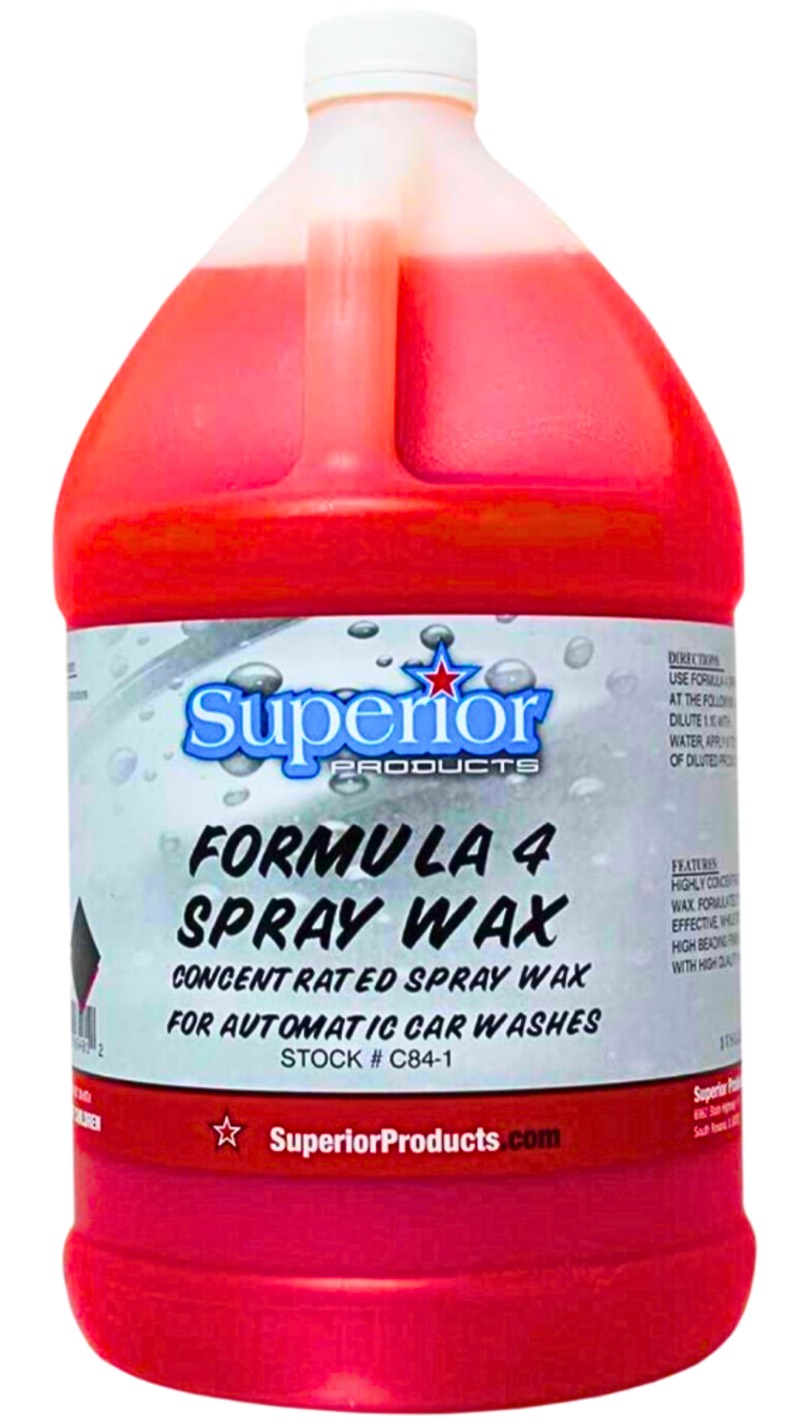
Superior Products Formula 4 Spray Wax

Superior Products Formula 4 Spray Wax

C84-1
5 / 5
AUTODETAILER.COM Rating

Formula 4 is a dilutable spray wax from Superior Products used as a rinse aid. Applied over the soap after the agitation wash, it sheets water off the paint to prevent water spots and saves a full rinse.

Price range
$22.99 / gallon (Superior Products)
Primary use
Rinse aid, drying aid, gloss
Health safety
Safe — pH 7.1
Intended user
Professional detailer, enthusiast/DIY, Automatic car wash
Safe on
Paint, glass, trim, wheels, most exterior surfaces
Dilution
  • 10:1 – Default, covers
  • 90% of use
  • 5:1 – Hot, direct sun, dark paint
Odor
Mild - Medium
How this product is used
  • Apply over the soap after the agitation wash, before rinsing
  • Use a dedicated second foam cannon and quick-disconnect between them
  • Sheets soapy water off the paint, buying working time in direct sun
  • Saves a full rinse on a mobile job
  • Leaves 1–2 weeks of visible beading
Limitations / Not safe for
  • Not a substitute for a sealant or coating
  • Do not apply directly to paint as a standalone spray wax — it streaks without water
  • Can streak if it dries on hot dark paint (buffs off with a damp drying towel)
  • Protection falls off after roughly two weeks
Our verdict
Pros
  • Saves an entire rinse on a mobile wash
  • Controls water spots in direct sun
  • Highly dilutable — 10:1 covers most work
  • Retail availability at O'Reilly, rare for pro-grade
  • Adds 1–2 weeks of beading for essentially no extra time
Cons
  • Rinse aid only — not real protection
  • Streaks if applied directly without water
  • Can streak on hot dark paint if it dries

What is Formula 4 Spray Wax?

Formula 4 is a dilutable rinse aid from Superior Products. It puts a hydrophobic layer on the paint so water beads and sheets off instead of sitting there — and water that isn’t sitting on the paint can’t dry and leave minerals behind.

That’s the whole mechanism. It doesn’t remove any solids from your water, or make it softer. It doesn’t deionize your water like a DI (or RO) tank. It just stops the water from hanging around long enough to become a problem.

It’s a category most detailers never hear about, because it comes out of the industrial car wash world. Automatic washes have used rinse aids for years — it’s what they spray before the blowers at the end of the tunnel. Armor All, Auto Magic and Carbrite all make one. Formula 4 is the one that’s actually easy to buy for detailers and hobbyists.

How do you dilute Formula 4 Spray Wax?

10:1 is my default. It’s what I use 90% of the time and it covers basically every use case.

There are situations where 10:1 doesn’t give you the beading you want — usually a mobile detailer working in the sun who needs a heavy hydrophobic barrier to buy more wash and rinse time. Then I drop to 5:1 and it solves all of it. Where that comes up most is hot, direct sun, dark paint.

You can also go the other way. I’ve diluted it at 15:1 in milder conditions and it still works, which is part of why a gallon lasts the way it does.

Does Formula 4 Spray Wax leave streaks?

If it dries on the paint because you’re working in insanely hot conditions, you might see some streakiness. It rubs off easily with a drying towel that’s already a little wet, ideally with some rinseless wash.

When you see people on Reddit saying Formula 4 leaves streaks, that’s more than likely what they’re talking about. It’s nothing to worry about, and in my experience it’s genuinely rare — even in direct sun on dark paint. The bottom line is, even the rare streaking is easily removed with some rinseless wash, and a quick pass with a microfiber.

How do you actually use it? My off label use…

Every mobile detailer knows that washing a car in direct sun creates a lose lose situation. There’s truly no way to avoid water spots altogether, BUT you can minimize them with the right product and strategy. Most guys will naturally rinse the soap off the paint after the agitation wash, then come in with a rinsing aid before a final rinse. In other words, they rinse the paint twice (not including if they use a pre foam cannon). Formula 4 can and should be applied ON TOP OF YOUR CAR SOAP after the agitation wash.

That’s right… apply it over the soap, after your agitation wash, before you rinse.

This is the big one, and I don’t think people highlight it enough. For a mobile detailer it does two things: it makes you faster, and it keeps you from rinsing the paint twice.

Here’s why it works. If you’re going to apply a rinse aid anyway, it makes no sense to rinse the soap off first. The soap is already mixed with water — put Formula 4 over the top and the whole thing beads up and starts falling off the paint. You’ll see white cloudy beads rolling off. I suggest keeping a separate foam cannon just for Formula 4 for this purpose. You can easily apply it anytime with a foam cannon locked and loaded ready to go.
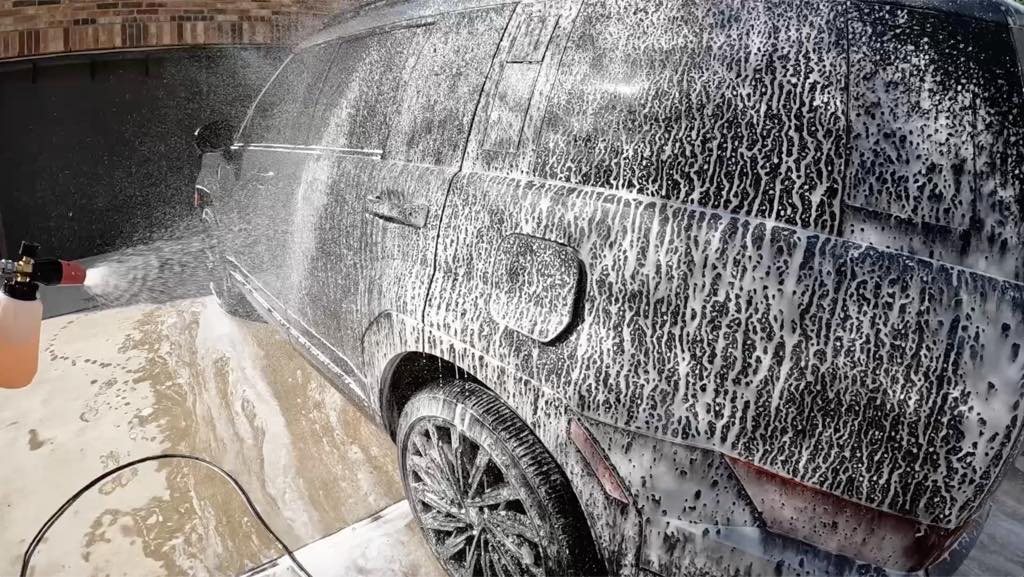
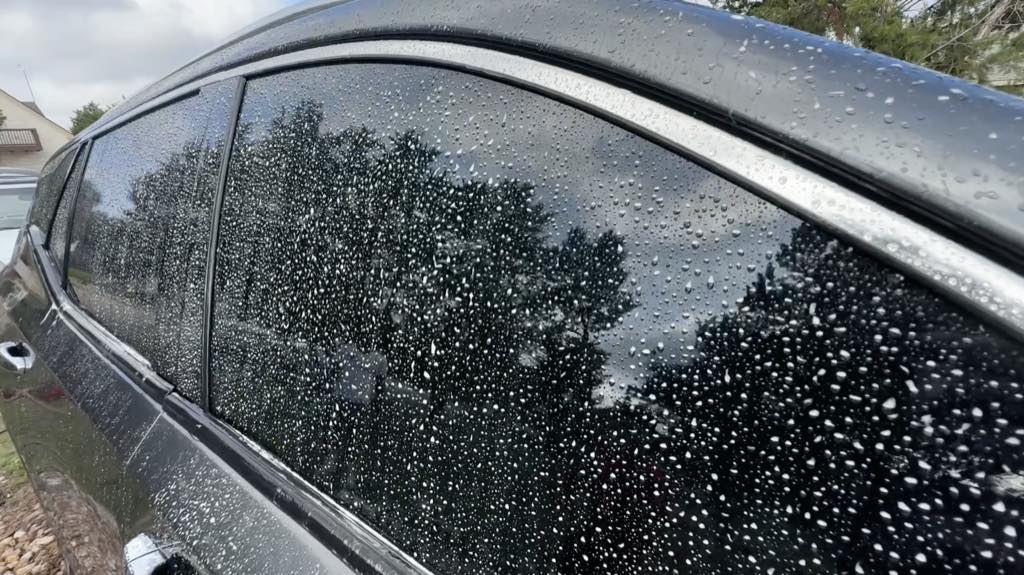
Formula 4 Spray Wax applied over the soap after the agitation wash, soapy water beading up on the paint
Soapy water beading and sheeting off the paint after Formula 4 Spray Wax was applied over the soap

Why apply Formula 4 Spray Wax on top of soap?

  1. It keeps you from rinsing twice.
  2. Less soap dries on the paint, so you get less natural streaking.
  3. The paint gets a glossy finish (and small amount of protection)
  4. It hurts nothing. It would be virtually impossible to damage something doing this.

I posted a video about this four years ago and I’m still saying the same thing.

Pro Detailer Tip

Keep a second foam cannon that you dilute Formula 4 in exclusively, and use it after every agitation wash. Way easier than using a spray bottle. A pump sprayer works, but over that much surface area it takes a long time — and in direct sun you’re beating the clock. With a dedicated cannon it’s a quick disconnect, swap it on, and start your rinse.

How long does Formula 4 last?

One to two weeks in normal conditions on a car parked outside. On nearly every car I’ve used it on I can still see beading around the 7 day mark, then it starts to fall off.

This is a dedicated rinse aid. It isn’t something I reach for when I want long-term protection.

What it is good for is handing a customer a little more than they paid for. You have to rinse the car regardless, so the gloss and the light protection cost you nothing extra. Two birds, one stone.

What does it actually cost per car?

A gallon runs about $23 on Superior Product’s website (and prices vary at O’Reilly nationwide), and it’s dilutable enough that you’re using somewhere between 10 and 20 cents of product per vehicle.

That’s the part worth sitting with. The thing that solves your water spot problem in the summer costs less per car than a bottle of water.

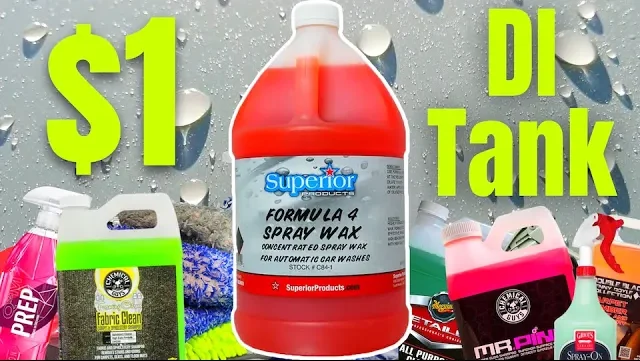
Formula 4 vs a DI tank

A DI tank removes the minerals from your water. That’s the real fix — I use a Pro 100 from Spot Free Water Systems, and with a TDS meter you can watch tap water read a few hundred parts per million and DI water read zero.

Formula 4 does something different. It doesn’t touch the mineral content at all; it just keeps less water on the paint. Fewer minerals sitting there means fewer spots. And the water that is on the paint is held in suspension because of the surface tension created by the spray wax, i.e. the water falls off quicker, and takes longer to dry on the paint causing fewer spots.

So it isn’t a replacement for a DI tank. It’s what you use when you don’t have one yet — and honestly, plenty of detailers with a tank still use it, because it saves time on top of everything else.

If you are going to buy a tank eventually, the only real difference between them is how much resin they hold, which will determine how long you go before changing it.

Formula 4 vs Regular Spray Wax

I get asked this constantly: can’t I just use the spray wax I already have?

I ran them side by side on the same car. Blasted one side with hard water, sprayed Meguiar’s Synthetic Xpress spray wax over the top, let it sit, rinsed it off. Nothing. The water didn’t bead, didn’t roll, didn’t behave any differently.

Then the same test on the other side with Formula 4, and the beading was obvious before I even started rinsing.

Where they are comparable: both will work as a drying aid. Spray either on a wet clean car, buff it off, get a glossy finish with some beading. That’s it. In the way that actually matters to a detailer working in the sun, they’re not similar products.

Formula 4 vs Auto Magic Easy Beads

Easy Beads is the closest thing to a true equivalent, and it works — I’ve sprayed it on filthy paint and had water sheet off the roof.

The problem is purchasing it. It’s distributor-only, it’s expensive, and it comes in a five-gallon drum. It’s mixed 300:1 in an industrial car wash, which tells you how little you need.

Formula 4 wins on the whole package: same function, one-gallon size, and you can actually buy it.

How do you wash in direct sun without water spots?

Formula 4 is a big part of it, but it isn’t all of it.
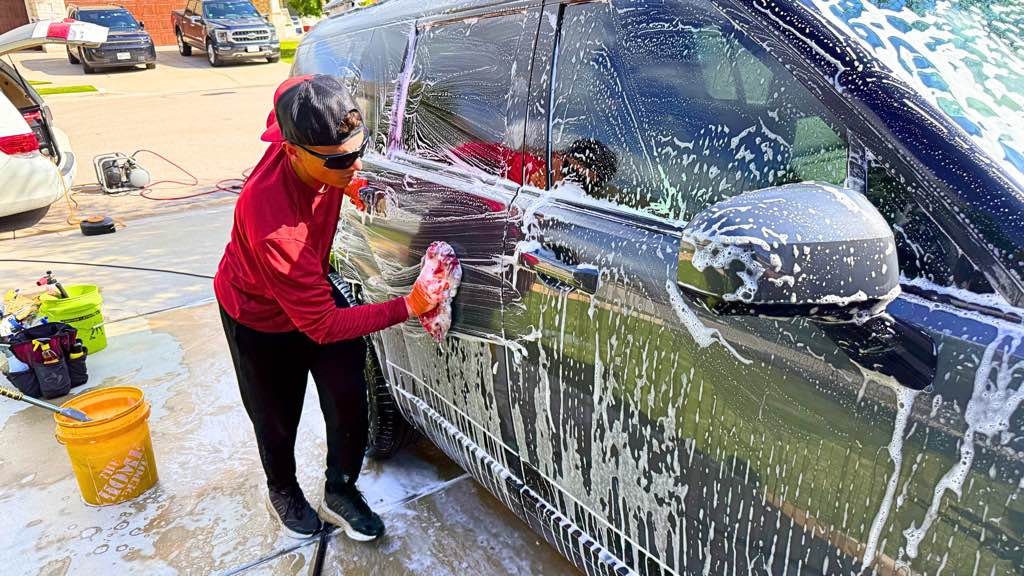
Detailer hand-washing a soapy black SUV with a wash mitt in direct sun, the paint still covered in car soap before the rinse

Water spots form because there are dissolved minerals in the water. Spray it on the paint, the water evaporates, and the solids stay behind. That’s hard water.

Add a capful or two of rinseless wash to your foam cannon. The surfactants hold the minerals in suspension rather than letting them settle on the paint. It isn’t the same as a DI tank actually removing them, but the practical result is similar.

Even then, you’ll get a few spots — usually on glass.

How to remove water spots

Most water spot removers are miserable. They’re bad in direct sun, bad in perfect conditions, dangerous for the paint, they stain, and they’re hard to get off.

I use Speedy Brite from Nanoskin — their organic wheel acid. Acidic cleaners break down the mineral deposits, and unlike something like Meguiar’s wheel brightener, this one doesn’t etch glass.

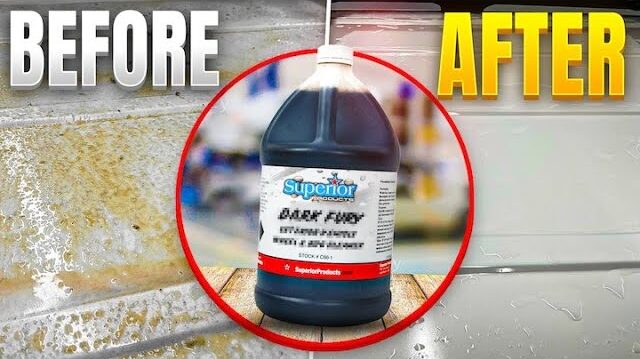
One thing worth being clear about: that’s an acid, and I’m using it on spots — If you just need a reliable and strong alkaline wheel cleaner for brake dust cleaning that rivals the strength of an acid, check out my review of Dark Fury wheel cleaner.

Dilute it 10:1 and keep it as a multi-purpose exterior cleaner. When you’re done washing, find the few spots that are left, spray, buff off with a microfiber towel. Put a little water on the towel and it won’t flash dry on you in the sun.

The point isn’t eliminating water spots completely. It’s eliminating 90% of them so the last 10% is a two-minute touch-up, and Speedy Brite is my secret weapon for the last 10%.

How should you not use Formula 4?

Don’t apply it directly to the paint as a traditional spray wax.

You technically could — but without water to carry it, it tends to streak. You could dilute it far enough to get away with it, and it still isn’t worth it. It’s a rinse aid. That’s what it’s good at, and that’s exclusively how I use it.

Where should you buy Formula 4 Spray Wax?

Your local O’Reilly. It tends to be the best price, and over-the-counter availability is genuinely rare for a professional-grade product like this.

It’s also listed on the Superior Products website. It used to be on Amazon and isn’t reliably stocked there any more.

Is Formula 4 Spray Wax worth it?

Yes, absolutely yes.

As a rinse aid that saves you a rinse, controls water spots in the sun, and adds a week or two of beading for essentially no extra time, it’s one of the highest-leverage products on a mobile rig. At 10 to 20 cents a car it’s close to free.

Just don’t buy it expecting protection. Buy it expecting extended wash time.

Frequently Asked Questions

Does Formula 4 Spray Wax leave streaks?

Only when it dries on hot paint before you can move it, and it buffs off with a slightly damp drying towel. That’s almost always what people online are describing.

Can I use Formula 4 instead of a DI tank?

It gets you most of the way there for a fraction of the cost, but it doesn’t remove minerals from your water the way a tank does. Think of it as the solution until you buy one.

What dilution should I start with?

10:1.

Is Formula 4 the same as a regular spray wax?

No. A spray wax like Meguiar’s Synthetic Express is a true finisher and protectant — it won’t make water bead and roll off while you rinse. I tested them side by side and the difference was obvious.

How long does a gallon last?

At 10:1 you’re using 10 to 20 cents of product per car, so a $23-$35 gallon covers a lot of vehicles.

Where can I buy it?

O’Reilly usually has the best price. It’s also on the Superior Products website.

Watch more videos

As an Amazon Associate I earn from qualifying purchases. Links to products in this review may earn us a commission at no extra cost to you.
Dark Fury Review

May 1, 2026

Dark Fury Wheel & Tire Cleaner Full Product Review

Dark Fury wheel and tire cleaner from superior products has become a popular alternative wheel cleaner to most acidic based cleaners. Here is everything you need to know.

Best alkaline alternative to acid wheel cleaners
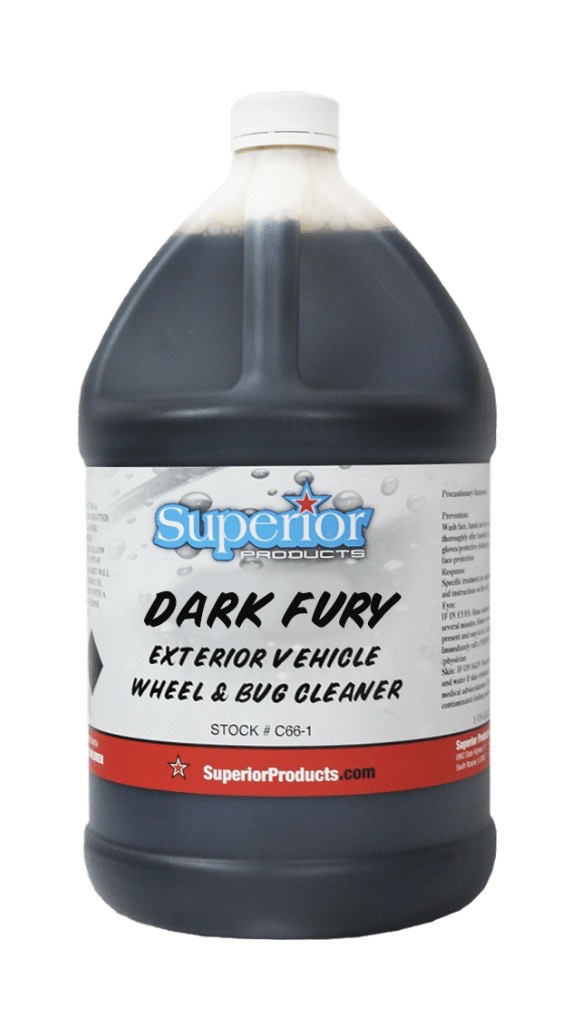
Superior Products Dark Fury

Superior Products Dark Fury

Stock #C66-1
4.5 / 5
AUTODETAILER.COM Rating

Dark Fury is a professional-grade alkaline (non-acidic) wheel and tire cleaner from Superior Products, available for pick up in retail stores like O'Reilly.

Price range
$25–$45 / gallon
Primary use
Wheel cleaning, bug & tar removal
Health safety
Contains Glycol Ether & Sodium Hydroxide, pH >12
Intended user
Professional detailer & enthusiast/DIY
Safe on
OEM clear coated wheels, Tires, Clear coat, Most exterior plastics
Dilution
  • 5:1 – Heavy brake dust
  • 10:1 – Baseline dilution
  • 20:1 – For anything other than wheels & tires
Odor
Strong
How this product is used
  • Strong alkaline (non-acidic) formula with a dark brown appearance when applied
  • Manufacturer recommends 4:1 dilution for most wheel and tire cleaning
  • Effective on brake dust, dirty tires, bugs, and exterior grime
  • Safe on trim and clear coated exterior surfaces
Limitations / Not safe for
  • Not recommended for bare aluminum or power coated wheels
  • Not safe on uncoated finishes of any kind
  • Never use full strength — always dilute before applying
  • Can cause ghosting at too high a concentration
  • Avoid on damaged surfaces like degrading clear coat or wheels with curb rash
Our verdict
Pros
  • Extremely strong & effective cleaner
  • Very affordable
  • Versatile (has many use cases)
  • Highly dilutable
  • Extremely effective alkaline alternative to acid based wheel cleaners
Cons
  • Strong fumes
  • Potential for ghosting on vulnerable exterior surfaces like degraded clear coat

What is Dark Fury Wheel and Tire Cleaner?

Dark Fury is and all in one alkaline (non acid) wheel and tire cleaner that doubles as an effective bug remover. This product has a pH >12, and has a dark brown (motor oil) like appearance when sprayed onto any car surface. Despite it’s high pH levels, it is designed to be mild on painted surfaces, clear coat, painted steel, plastic, and factory aluminum wheels when diluted properly.

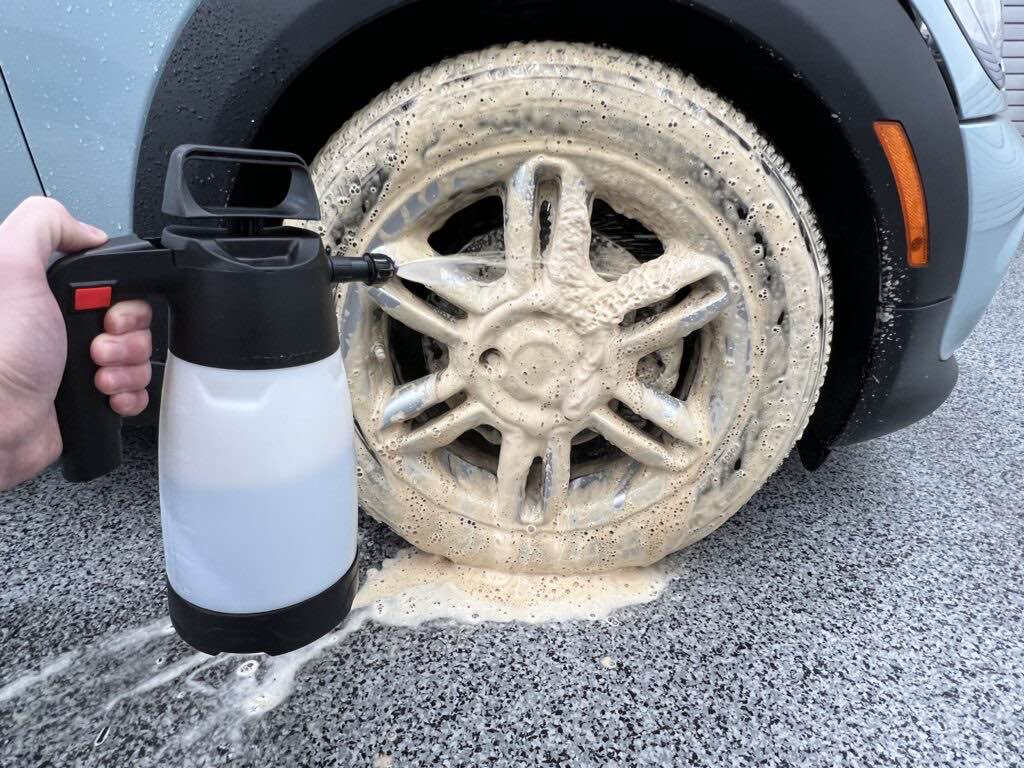
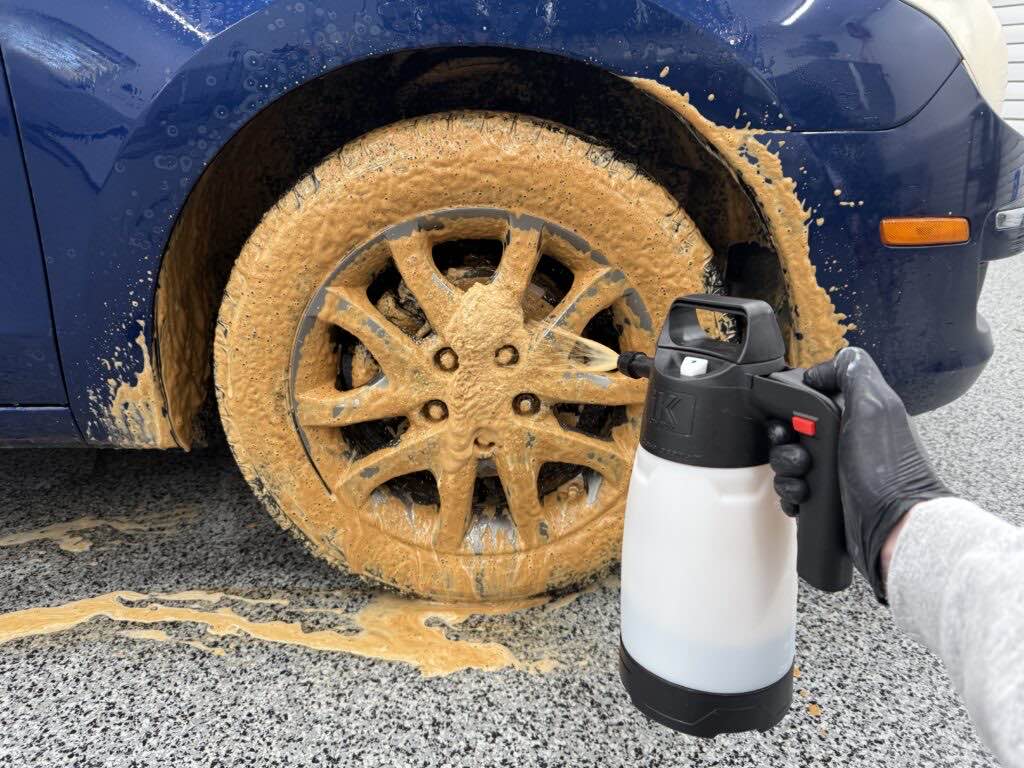
Dark Fury foaming tan across the alloy wheel and tire of a blue car, sprayed from a black hand pump sprayer at stronger than 4:1
Dark Fury diluted <4:1
Dark Fury at 10:1 foaming over a silver alloy wheel and tire on a grey car, applied with a hand pump sprayer
Dark Fury diluted 10:1

Is Dark Fury Wheel Cleaner Safe?

Yes — Dark Fury is safe on most factory exterior surfaces when used at the correct dilution. After more than 3 years of regular use, I have never damaged a vehicle surface with this product, including testing it at full concentration against the manufacturer’s recommendations.

How I dilute Dark Fury:

The manufacturer recommends a 4:1 dilution as the standard starting point. Here is how I actually use it based on the surface:

  • 5:1 — OEM factory clear coated wheels, tires, and wheel wells. This is my standard wheel dilution. It delivers strong brake dust removal and more than enough degreasing power on tire sidewalls.
  • 10:1 — Exterior surfaces, bugs, and miscellaneous exterior dirt on vehicles in good condition.
  • 20:1 — Older vehicles, degraded clear coat, or any exterior surface I judge as more vulnerable.

I have used Dark Fury at full concentration on OEM factory clear coated wheels and never observed damage. That said, follow the manufacturer’s directions — I test products at extremes specifically to understand their limitations so you don’t have to.

What is “ghosting” and should you be concerned?

Ghosting is the most commonly reported issue with Dark Fury. It refers to a faint outline or stain left on a painted surface after the chemical is rinsed off.

A few things worth knowing:

  • Ghosting is not unique to Dark Fury — it is a known risk when using any strong alkaline cleaner on clear coat that is older, oxidized, or slightly degraded.
  • It is more likely to occur at higher concentrations, which is why starting diluted and working up is always the right approach.
  • Strong alkaline cleaners can also leave chemical staining on degraded black plastic trim and chrome — again, not specific to Dark Fury but worth noting.

The practical takeaway: if you are cleaning a vehicle with older or questionable clear coat, start at 20:1 and test a small area before full application.

Dilution ratios & cost per use
Dilution ratio Diluted gallons Total oz. ready-to-use Cost per oz. Cost per 32 oz. bottle
5:1 Heavy brake dust / wheels 6 gal768 oz total 768 oz $0.052~$0.05 / oz $1.67
10:1 General exterior / bugs 11 gal1,408 oz total 1,408 oz $0.028~$0.03 / oz $0.91
20:1 Vulnerable surfaces / older clear coat 21 gal2,688 oz total 2,688 oz $0.015~$0.01 / oz $0.47

Based on 1 gallon ($40.00) of Dark Fury concentrate. 1 gallon = 128 oz. Diluted volume = concentrate + water.

Scroll to view full table →

How does Dark Fury compare to acid wheel cleaners?

Dark Fury is an alkaline cleaner, not an acid cleaner — and that distinction matters way more than brand. Acidic wheel cleaners objectively dissolve mineral deposits & clean brake dust better than alkaline cleaners, but because the ingredients can be hazardous to your health, the question is: What’s the best non acidic alternative?

Which is safer on wheels?

Dark Fury at the proper dilution is (I dare to say) ‘significantly’ safer on factory clear coated wheels – and basically all wheels. Acidic wheel cleaners react aggressively with bare metal like aluminum, and notoriously discolor, and etch aftermarket wheels depending on the situation. The Dark Fury SDS sheet specifically notes its surfactants are designed to prevent high pH from pitting aluminum. This is a key safety differentiator.

One practical advantage of alkaline cleaners that rarely gets mentioned: overspray. Acid wheel cleaners can etch glass, trim, and painted surfaces on contact — Meguiar’s Wheel Brightener is a known example of a product that has etched glass from overspray alone. With an alkaline cleaner like Dark Fury at proper dilution, overspray on surrounding surfaces is a non-issue. For mobile detailers working in tight spaces or cleaning wheels without protecting adjacent panels, that’s a meaningful difference in real-world use.

Which is more versatile?

Acid based wheel cleaners are largely single purpose chemicals. They are extremely effective at dissolving brake dust, they’re the best at it, and that’s (generally) all they do. Dark Fury can be diluted for bug removal, lower rocker panel cleaning, general exterior all purpose cleaning, tires, and wheel wells. That is a real advantage for someone looking for multi purpose chemicals – It is one of the most versatile exterior cleaning products I have used.

When is an acidic wheel cleaner still better?

Acidic wheel cleaners are more effective at dissolving brake dust, there’s no getting around it. When dealing with an OEM factory clear coated wheel that is riddled in layers of heavy brake dust, you may find that no alkaline wheel cleaner will touch it. This won’t be solved with a different brand of alkaline cleaner. There are some wheels that are so covered, only an acid will reasonably make a dent.

Pro Detailer Tip

Any chemical you spray on a vertical surface is fighting gravity — wheels, tires, wheel wells, and bug-covered bumpers all present the same challenge. A foam pump sprayer is one of the best ways to apply Dark Fury because the foam clings to the surface and extends dwell time, which directly increases cleaning power. For tough dirt like heavy brake dust or baked-on bugs, that extra dwell time does the work for you and significantly reduces the scrubbing required. I probably have smaller forearms because of it, but it’s really helpful 🙂

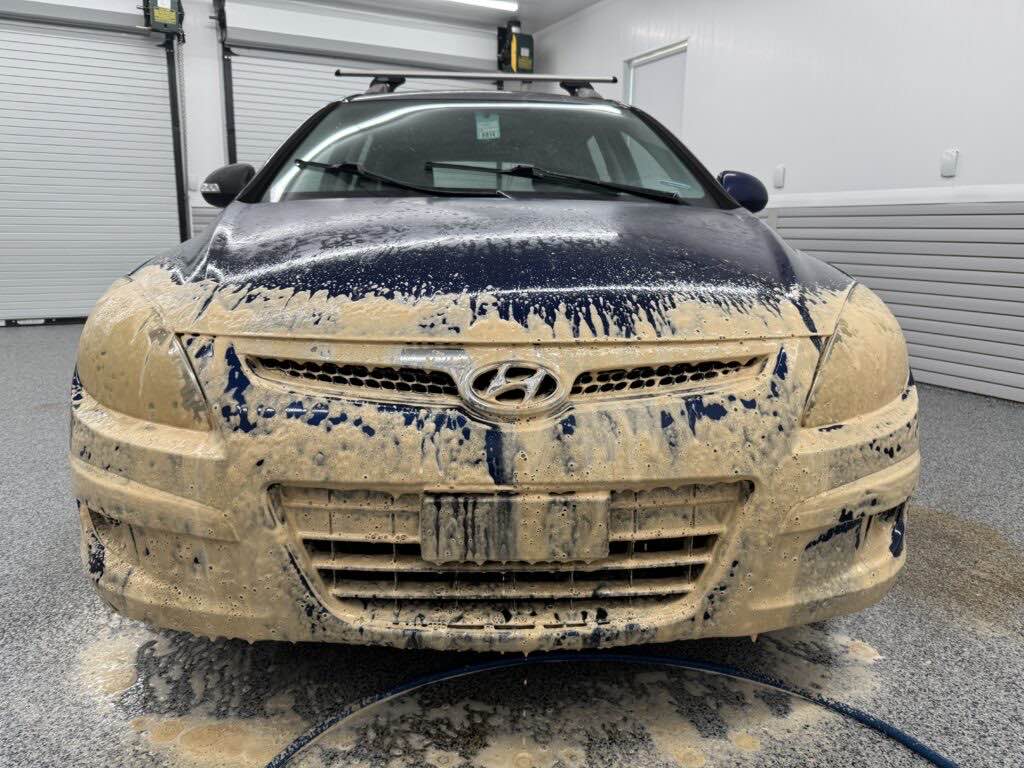
Tan Dark Fury foam covering the grille and front bumper of a dark blue Hyundai at roughly 15:1, leaving the older clear coat unmarked
Dark Fury applied with a foam pump sprayer at ~15:1 on older clear coat — zero ghosting, as expected.

Is Dark Fury Wheel Cleaner worth it?

Yes — for most detailers, Dark Fury is one of the best value wheel and tire cleaners available. After more than 3 years of regular use it is still my go-to alkaline wheel cleaner. It is also the product I recommend most to detailers looking to move away from acid-based chemicals, or at least looking to have a non acid alternative.

The case for it comes down to it’s strength, cost, and versatility. First, the cleaning power is genuinely exceptional for an alkaline formula — it handles heavy brake dust, baked-on grime, bugs, and road film without the surface risk that comes with acid cleaners. Second, the dilution flexibility means your cost per use is extremely low compared to most comparable products — at 20:1 for general exterior cleaning you are getting dozens of gallons of ready-to-use cleaner from a single $40 gallon (if not cheaper). Third, the versatility means it replaces multiple products in your chemical line up — wheel cleaner, bug remover, and exterior all-purpose cleaner in one bottle. The versatility may be less important to DIY detailers, but for professionals it is hard to overvalue.

The honest limitations are real but manageable. The fumes are strong and ventilation matters. You should never use it full strength on anything you are not willing to test first. And on vehicles with genuinely degraded clear coat, you need to start diluted and work up cautiously.

But for a professional mobile detailer running 10+ details a week on everyday vehicles with OEM factory paint and wheels, Dark Fury at 5:1 on wheels and 10:1-20:1 everywhere else is about as close to a universal exterior chemical as you will find at this price point. The value case is difficult to argue with. Consumers and pro’s alike stand to benefit equally from this product. For another product I can’t live without – Click here to check out my full review on Superior Product’s Formula 4 Spray Wax.

Frequently Asked Questions

What pH is Dark Fury, and is it acidic or alkaline?

Alkaline — pH over 12, built on sodium hydroxide and glycol ether rather than acid. Acidic wheel cleaners are still the best at dissolving brake dust, and they are safe on factory clear coated wheels when used correctly. They are simply harsher: more potential to etch bare aluminum, discolor aftermarket wheels, or damage glass, trim and paint from overspray. An alkaline cleaner leaves you more margin for error.

Where should I buy Dark Fury?

Dark Fury is available nationwide at Oreilly. For in store retail purchasing, this is undoubtedly the easiest way to buy it. It is also available at Superior Product’s website, and amazon.

How do I dilute Dark Fury Wheel & Tire Cleaner?

The manufacturer recommends a 4:1 dilution as a starting point. In practice, 5:1 works well for OEM clear coated wheels, tires, and wheel wells; 10:1 for exterior surfaces and bug removal on vehicles in good condition; and 20:1 for older vehicles or degraded clear coat. Always start more diluted and work up — never use full strength.

Is Dark Fury safe for all wheels?

Dark Fury is safe on OEM factory clear coated wheels, painted steel, most exterior plastics, and tires. It is not recommended for bare aluminum, power coated wheels, or uncoated polished finishes of any kind. If you are unsure about your wheel type, start at a high dilution and test a small area before full application.

Is Dark Fury safe to use on other car surfaces?

Yes, at proper dilution. Dark Fury at 10:1 or higher is safe on clear coated paint, trim, and most exterior plastics. The main risk is using it too concentrated on surfaces with degraded or older clear coat, which can cause ghosting — a faint chemical stain left after rinsing. Always rinse thoroughly before the product dries, and avoid letting it dwell on any surface you are unsure about.

Watch more videos

As an Amazon Associate I earn from qualifying purchases. Links to products in this review may earn us a commission at no extra cost to you.